
By David A. Welker, an 7th generation great grandnephew of Oliver Butterfield
Oliver Butterfield7 (William6, Samuel5, Nathaniel4, Benjamin3, Thomas2, Benjamin1) was born on April 10, 1759 to William Butterfield and Rebecca Parker Butterfield, in Londonderry, New Hampshire. In 1771 Oliver moved with his parents to Francestown, NH. [1]
1777 – The Battle of Bennington
Oliver was drafted on July 21, 1777 to serve in Captain Peter Clark’s Company of Colonel Sickney’s Regiment (the 11th New Hamshire Militia Regiment), General Stark’s Brigade of New Hampshire Militia. The process that brought Oliver to this service began when Francestown residents concluded in early 1777 that they needed a new, more fair system for raising men for the militia that also was more rapid in responding to quickly arising crises. When in May 1777 an alarm was received that a British army from Canada was heading to strike New England, Francestown twice raised troops to respond to such alarms and each time they returned in under three weeks, once it was concluded the alarm was premature. [2]
However, within a week of the second group’s return another, more serious alarm arrived and the town raised a third group of men for the militia. This alarm was indeed more serious and was sparked by what became known as the Campaign of 1777, in which British General John Burgoyne advanced south from Canada to Lake Champlain, where he first recaptured Ft. Ticonderoga for the British. This vital objective secured, Burgoyne and his army marched south along the Hudson River, heading for Albany. There he hoped to be joined Sir William Howe’s forces, after which the two armies would advance north along the Hudson River from British-controlled New York City, splitting New England from the rest of the colonies.
In response, the New Hampshire legislature voted to raise two brigades. Although one brigade could not be formed quickly enough the other, commanded by Major General John Stark and formed in the western portions of New Hampshire and sent forward to the brigade’s meeting place at Manchester, NH.
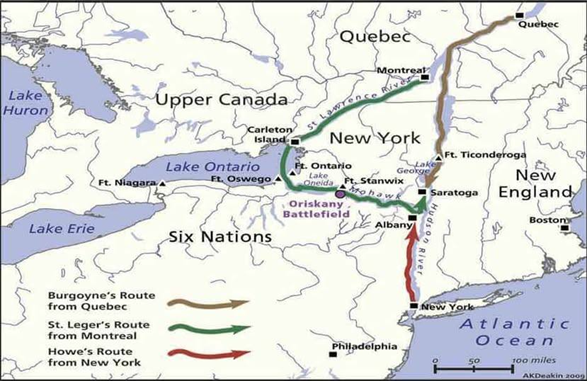
Burgoyne’s plan for the Campaign of 1777
Doing its part, Francestown began raising troops and a town meeting “voted Each man Now Going into the armey three pounds for the term of 2 months.” Soon “a company was mustered in at New Boston July 23, of men from that town together with those from Deering, Antrim, Greenfield, Lyndeborough, and Francestown. Of this company Peter Clark of Lyndeborough was captain…”
Drafted to meet his town’s quota, Oliver Butterfield traveled from Lyndeborough, NH to Charlestown N.H., where he found his company, as well as “most, if not all,” of Stickney’s Regiment. Next the entire regiment marched from that place to Manchester, Vermont. While there, Oliver went with a small party after stores and then returned to the regiment, which had by then moved to Bennington, Vermont. From this point the to end of his first service Oliver remained with Sickeny’s Regiment. [3]
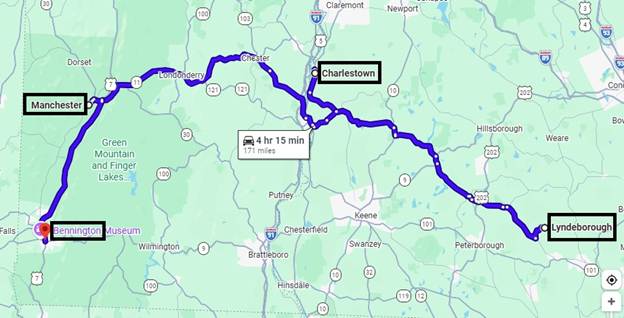
Roughly the route Oliver reported taking to meet his company and regiment, as well as the route to the Battle of Bennington
Burgoyne’s British, Loyalist, Hessian, and Native American Indian force left Canada on June 16th and on July 6th as intended, retook Ft. Ticonderoga for England. But as he advanced further south along the Hudson Burgoyne’s supply line reaching to Canada was stretched thin, forcing him to seek opportunities to resupply his command. Learning of horses and supplies in Bennington, Vermont, a slight detour but still on his southward route, Burgoyne divided his army. While he stayed with the main force, a portion commanded by Lt. Col. Friedrich Baum moved toward Bennington,.
Baum halted his command near Walloomsac, New York, about 10 miles from his objective of Bennington, Vermont, in order to first secure the Walloomsac River crossings ahead of sending out raiders to capture the supplies Burgoyne sought. Amidst a growing rainstorm, Baum’s command erected two redoubts—fortified positions—on high ground that controlled the approaches to the river’s main crossing, Wilcox Bridge.
Meanwhile, Patriot General Stark—a veteran of the Battles of Bunker Hill and Trenton—advanced his brigade to strike Baum’s advanced, isolated force on August 16, 1777. Early that day Oliver Butterfield and the rest of Stark’s Brigade left their Vermont-based camp, just across the NY border, and while one half of Stark’s force moved south, Oliver and Clark’s Company moved north. The southern force marched west, crossing the Wallomsac River before turning north to strike Baum’s Dragoon Redoubt, built to hold the high ground west of the river. Meanwhile, Oliver Butterfield and the other half of Stark’s command moved north, dividing once again when into New York. Half of this force continued due west to strike the British and Canadian force holding Wilcox Bridge, while Oliver and Clark’s Company was part of the force advancing southwest, heading to strike the Tory Redoubt, constructed by Loyalists to control access to Wilcox Bridge from the east and south.
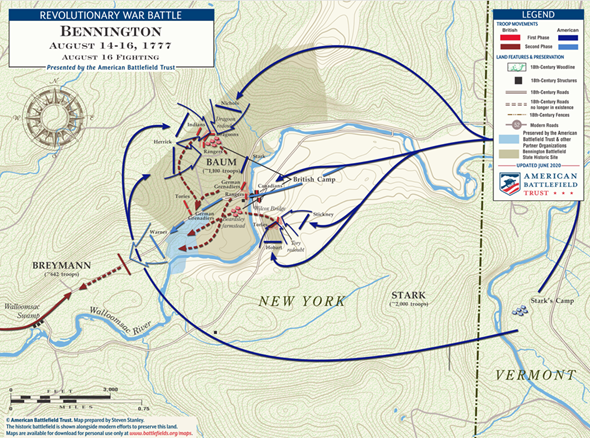
Movements to the Battle of Bennington, August 14-16, 1777
Approaching the redoubt, the American forces once more divided, with Hobart’s Regiment attacking the fortification’s left flank, while Oliver Butterfield and Stickney’s Regiment struck the Tory Redoubt’s right flank. After heavy fighting, the Loyalists fled and abandoned the redoubt to the New Hampshire militiamen.
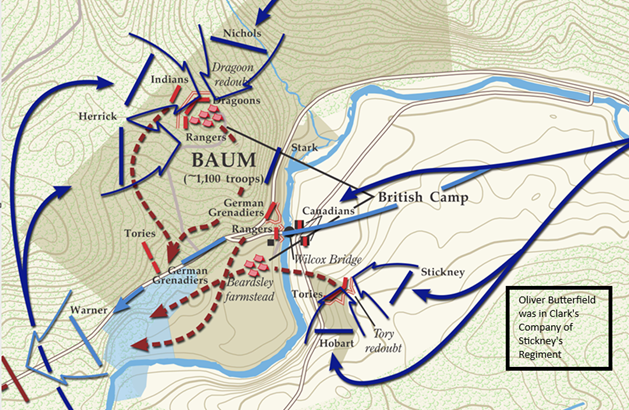
Detail of the battle on August 16, 1777
Starke’s other attacks were just as successful, mortally wounding Lt. Col. Baum and forcing his men to flee, leaving the Americans in command of the three defensive positions and the ground. Darkness ended the battle, which cost Burgoyne more than 200 dead and wounded and 700 prisoners or missing. American casualties were only about 70 men killed and wounded.
The Battle of Bennington was Burgoyne’s first taste of defeat in the Campaign of 1777, but not the last. Two months later Burgoyne would surrender his army at Saratoga—a battle in which Oliver’s brother Isaac Buterfield took part—turning the tide of war in America’s favor.
Oliver Butterfield had been there through it all. On Sept. 26, 1777 he was discharged and returned home to Fancestown.
1779
Oliver Butterfield once again joined the New Hampshire Militia on July 20-22, 1779, when Colonel Moses Kelley recruited him into Kelley’s Regiment, in which the colonel himself was acting as muster master. Kelley had been authorized to recruit a regiment when the New Hampshire legislature in June approved raising men “for the defense of Rhode Island.”
These men were needed to watch and potentially respond to any British movement from the Newport, Rhode Island area, which they had held since 1776. The request to New Hampshire for more troops had come from Congress, which on May 4, 1779 finally acceded to Rhode Island delegates’ pleas for an additional 1,500 troops to defend Rhode Island. This was necessary because Rhode Island’s small number of troops had been pushed to the limit with monitoring the British forces in Newport for years. [4]
Oliver never actually served with Kelley’s Regiment, however, and was instead assigned to Captain Daniel Emerson’s Company in Col. Hercules Mooney’s Regiment. Mooney’s Regiment was sent to Rhode Island, where Oliver served from July 12, 1779 to January 15, 1780. In his pension application Oliver recorded that “he went to Providence [Rhode Island] & joined his regiment there. Marched from that place to Tiverton [Rhode island, on northern Aquidneck Island, near Newport] . His company was stationed at Tiverton [unintelligible] part of the regiment was at other places till the British Army left Newport. Staid there awhile & then returned to Providence & remained there till his time was out. The exact time he does not remember, but thinks it was about the first of January.”
Oliver had received a £30 bounty and £12 of travel money for journeying 130 miles from Francestown to Rhode Island. For his second term of service Oliver was paid £73, 12 shillings. He also received compensation and £14, 18 shillings for subsistence. [5]
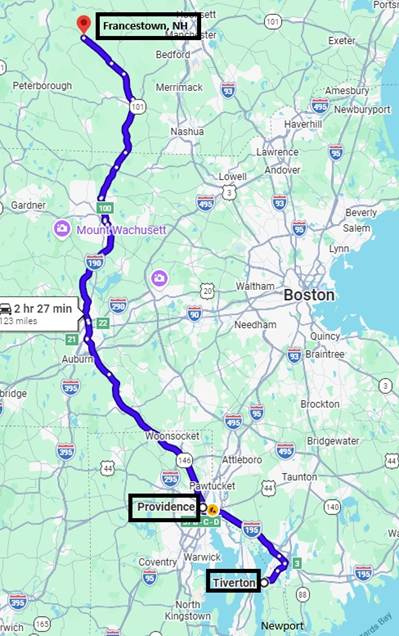
Oliver Butterfield’s 1779 route to Rhode Island
Post-War Life
After Oliver’s second term of service he returned to Francestown, NH and assumed control of the farm and property where he was born (which was known locally for its first owner John Balch). On June 14, 1783 he married Hannah Dane Butterfield, from New Boston, NH. Together they had two children Hannah (1787-1795) and John (1803-1891). The history of Francestown records Oliver writing a memory of his youth noting that “Patty Fairchild, who lived at Daniel Fuller, had the first umbrella & was laughed at b those wedded to the past.” Oliver died on January 12, 1836 in Francestown, NH. [6]
Order of Service
- Captain Peter Clark’s Company, Colonel Stickney’s Regiment (the 11th New Hamshire Militia Regiment), in General Stark’s Brigade of New Hampshire Militia – July 21 to September 21, 1777.
- Recruited to Col. Moses Kelley’s Regiment but served in Captain Daniel Emerson’s Company in Col. Hercules Mooney’s Regiment – July 12, 1779 to January 15, 1780.
[1] Smith, Cora Elizabeth Han Certain Early Ancestors (Edwards Brothers: Ann Arbor, Michigan, 1944), p. 24.
[2] Complied Service Records of Soldiers Who Served in the American Army During the Revolutionary War, National Archives, RG 93.
[3] Rev. W. R. Cochrane and George K. Wood History of Francestown, N. H.: From its Earliest Settlement April, 1758 to January 1, 1891 (Published by the Town: Nashua, NH, 1895), pp. 255-257; Muster Rolls and Petitions, 1777-1799, National Archives.
[4] Rhode Island Legislature to George Washington, 26 April 1779, National Archives, https://founders.archives.gov/documents/Washington/03-20-02-0205.
[5] Complied Service Records of Soldiers Who Served in the American Army During the Revolutionary War, National Archives, RG 93; Muster Rolls and Petitions, 1778-1787, National Archives.
[6] Cochrane, History of Francestown, p. 471.