

Isaac Butterfield’s Revolutionary War Service
By David A. Welker, a 7th generation great grandnephew of Isaac Butterfield
Isaac Butterfield7 (William6, Samuel5, Nathaniel4, Benjamin3, Thomas2, Benjamin1) was born on 23 February, 1749 to William Butterfield and Rebecca Parker Butterfield, in Londonderry, New Hampshire. On March 12, 1769 he married Sarah Sherwin Butterfield in Dunstable, Massachusetts. Before his parents moved to Francestown, NH in 1771, Isaac in 1770 had moved to settle on Society Land and on October 12, 1774 Isaac joined with other Society Land settlers in petitioning the royal governor to legalize their possessions. By the time that Isaac enlisted in the army in 1777, he and Sarah had borne four children together (seven-year-old Isaac Jr., four-year-old Sarah, two-year-old Hepzibah, and newborn Joel). [A] [1]
On September 30, 1777 twenty eight-year-old Isaac enlisted in Captain Peter Clark’s Company, of Colonel Daniel Moore’s Regiment (the 9th New Hampshire Militia Regiment). He enlisted for 25 days at a pay rate of £4, 10 shillings per month, to which was added expenses of £1, 13 shillings, five pence for travelling from Lyndeborough to Bennington, NH, where the regiment mustered for service. [2]
The 9th New Hampshire Militia Regiment was called up on September 29, 1777 as reinforcements for the Saratoga Campaign. Upon reaching General Horatio Gates’ army in New York, Isaac and Moore’s 9th New Hampshire Militia Regiment were assigned to Brigadier General William Whipple’s Brigade. The three other New Hampshire militia regiments joining Moore’s Regiment in Whipple’s Brigade were Bellow’s Regiment, Chase’s Regiment, and Welch’s Regiment, comprising 1,353 to 1,376 men (according to the return of Oct. 16, 1777).
Isaac and Whipple’s Brigade took an active part in the Bemis Height’s action of the Battle of Saratoga, on October 7, 1777, the second portion of the battle that forced British General Burgoyne to surrender his army. As a result of their meritorious conduct that day, General Whipple and Colonel James Wilkinson were chosen by Major General Horatio Gates to determine terms of capitulation, along with two representatives of General Burgoyne. Whipple then signed the Convention of Saratoga, the effective surrender of General Burgoyne and his troops.
Isaac Butterfield was discharged from Clark’s Company and Moore’s Regiment on October 24, 1777, and returned home to New Hampshire—paid £1, seven shillings, four pence for his 164 mile journey—yet his support of the Revolution was not at an end. After returning to his farm on Society Land, Isaac paid £1701 in taxes in 1780 and 1781 which supported the Revolution. [3]
Post-War Life
Isaac and Sarah had five more children together after the war, a total of nine children. Living on his Society Land property until in old age, he and Satah moved first to Francestown, NH, then Acworth, NH, next to Homer, NY, and finally to LeRoy, NY, probably to live with their son John, who had moved to nearby Caledonia, NY. Isaac Butterfield died on June 6, 1844, at the age of 95 and is buried in Caledonia Rural Cemetery, Caledonia, Livingston County, NY.
Order of Service
- Captain Peter Clark’s Company, of Colonel Daniel Moore’s Regiment (the 9th New Hampshire Militia Regiment) – September 30-October 24, 1777
[A] By the mid-1700s, New England was crowded and Connecticut and Massachusetts farmers began seeking new land. Groups of settlers moving into what is now New Hampshire petitioned the Royal Governor, who (wanting more land for his colony) issued grants to groups of settlers to start towns. One of these grants was known as the Society Land, in Hillsborough County, NH. It originally comprised all the territory now included in the towns of Deering, Antrim, Hancock, Bennington, Francestown, and the north part of Greenfield, NH. The name probably derives from the fact that this territory was not granted in townships, but was reserved and divided equally among the members of the “society” or syndicate of proprietors of the Masonian Patent (sometimes also known as Cumberland). Francestown was the first town in the Society Land district to be incorporated, on June 8, 1772 , with the New Boston Addition within its lines. Then followed Deering, Jan. 17, 1774; Antrim, March 22, 1777; and Hancock, Nov. 5, 1779. These towns covered the entire tract except a small piece in the southern part, and this was combined with Lyndeborough, Gore, and enough of Peterborough and Lyndeborough to make a small township, and incorporated as Greenfield June 15, 1791. Bennington was composed of parts of Greenfield, Francestown, Deering, and Hancock, and was incorporated Dec. 15, 1842, and lies nearly in the center of the original Society Land.
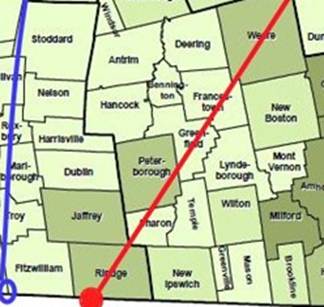
Map showing the southern portion of the Society Lands, bounded on the east by the red line and on the west by the blue line. Francestown—the first incorporated town—is in the map’s center.
[1] Smith, Cora Elizabeth Han Certain Early Ancestors (Edwards Brothers: Ann Arbor, Michigan, 1944), pp. 20-22.
[2] Muster rolls and petitions, 1777-1779, New Hampshire; Muster Rolls and Petitions, 1777-1779, Lyndeborough, New Hampshire, September 1777; Complied Service Records of Soldiers Who Served in the American Army During the Revolutionary War, 1775-1784, National Archives, RG93, Moore’s Regiment Militia.
[3] Tax books, 1775-1781, Society Land, Hillsborough County, New Hampshire; Tax books, 1781-1782, Society Land, Hillsborough County, New Hampshire.