

By David A. Welker, a 7th generation great grandnephew of Robert Butterfield
Robert Butterfield7 (William6, Samuel5, Nathaniel4, Benjamin3, Thomas2, Benjamin1) was born on November 16, 1756 to William Butterfield and Rebecca Parker Butterfield, in Londonderry, New Hampshire. In 1771 Robert had moved with his parents to Francestown, NH. [1]
1776
Sometime before July 22nd, 1776 twenty-year-old Robert was recruited into Colonel Daniel Moore’s Regiment of New Hampshire Militia. Moore’s Regiment had apparently spent the war’s earliest days deployed in protecting the New Hamshire coast, although it remains uncertain if Robert took part in this. [A] [2]
On July 3, 1776 the New Hampshire legislature voted to raise 1,500 men to reinforce the Northern Army—which had just returned from Canada, after Generals Montgomery and Arnold’s defeat at the Siege of Quebec—by encouraging men to transfer from existing New Hamshire Militia companies. Each company was assigned a quota to reach and the men were offered bounties and lodging money as an incentive to enlist. [3]
Private Robert Butterfield was one of the 30 men—along with his older brother Samuel Butterfield—who on July 22, 1776 were mustered into (essentially voluntarily transferred) to Barron’s Company , in Wingate’s Regiment along with other men “raised for Canada out of Colonel Daniel Moore’s Regiment.” The muster roll noted that he enlisted for “about 4 months,” “belonged to Francestown,” and was paid £ 9, 18 shillings. He was allotted an additional £ 5 to cover billeting. [4]
Robert and his militia comrades were attached to the 2nd New Hampshire Militia Regiment, commanded by Col. Joshua Wingate, which had been raised to reinforce the Northern Army in expectation of repelling any British advance from Canada that might take advantage of Arnold’s ongoing retreat. Robert and Barron’s Company of Wingate’s Regiment marched initially to the rendezvous point, the fort at Number 4, NH—near Charlestown, NH—joining Col. Wyman’s NH Militia Regiment. From there they marched to Fort Ticonderoga, to join the Northern Army by August 1776. Robert was posted to nearby Mt. Independence, Vermont, securing the North (Hudson) River’s eastern bank. He “was dismissed from the service in November on account of being sick—about a month before his term of service was out.” [B] [5]
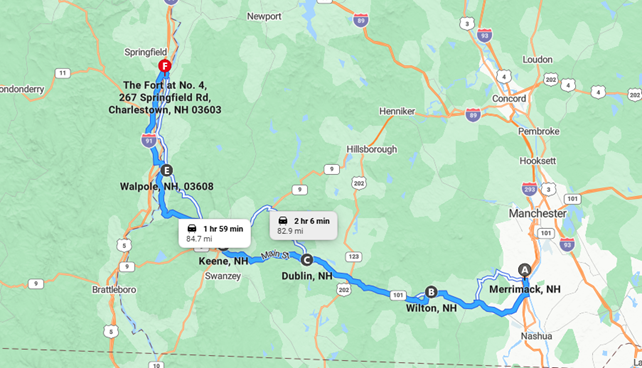
Robert Butterfield’s journey with Capt. Barron’s Company to the fort at Number 4, after mustering in (transferring) from Col. Daniel Moore’s Regiment on July 22, 1776 [6]
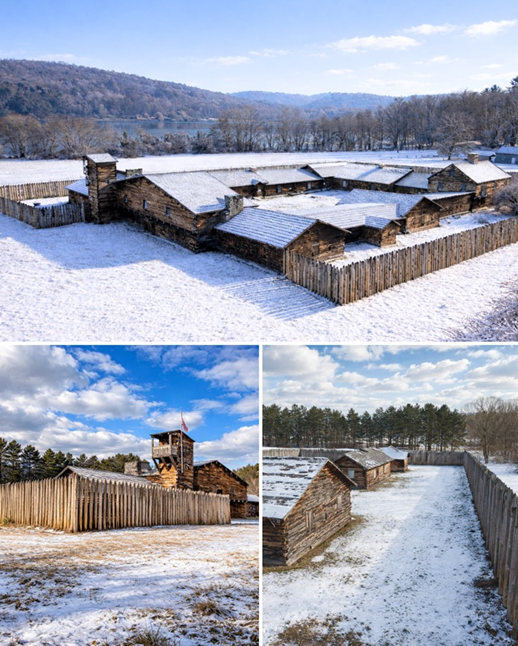
The fort at Number Four, where Samuel Butterfield and Barron’s Company of Wingate’s Regiment met Wyman’s Regiment, before marching on the Ft. Ticonderoga.
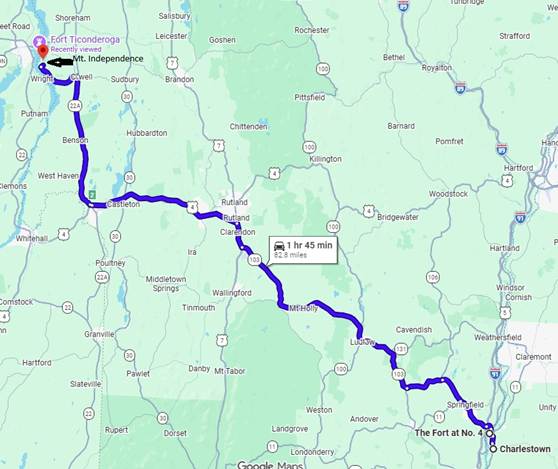
The approximate route Robert Butterfield and Wingate’s Regiment marched to Mt. Independence, Vermont, across the North River from Ft. Ticonderoga, NY
1780
Robert Butterfield joined the New Hampshire Militia again on July 4, 1780—once more along with his older brother Samuel Butterfield—in Captain Jonas Kidder’s Company, of Col. Moses Nichols’ Regiment (also known as the 5th New Hampshire Militia Regiment). In this enlistment 23-year-old Robert served as a substitute for James Fisher, who probably had been drafted and wished to avoid service. He was to serve a term of three months and 20 days, for pay of £134 a month (totaling £491, 6 shillings). He also received £76, 10 shillings for his travel to reach West Point, which was recorded as a distance of 255 miles from his home of Francestown, NH. [7]
These troops were raised because the military situation in summer 1780 was tense and unsettled. The British Army and Fleet held New York City and the surrounding area, American forces held the North (Hudson) River and its surrounding area, while the French Fleet and 6,000 French solders on July 11 had arrived in Newport, RI. Washington was rightly concerned that before French forces could take any action, the British would try seizing the initiative by attacking the critical West Point area, to gain control of the river and split the new American nation in two. For this reason Washington needed more troops at West Point.
Although it remains uncertain when Robert arrived, by September 27, 1780 he’s listed on a muster roll of men in Capt. Kidder’s Company, posted to the Hudson Highlands, near West Point. According to Robert’s pension application “he was stationed a short time at West Point, then across the river, inland at Robinson’s Farm, till after Arnold left West Point, then returned to West Point & remained there till dismissed.” Robert was discharged on October 23, 1780, after which he returned to New Hampshire. [8]
Although Robert witnessed no fighting during this second service with the militia, there was considerable excitement of a very different nature. On September 23, 1780 American General Benedict Arnold’s plan to hand over West Point to the British was exposed when British Major John Andre was captured. Arnold had promised British General Clinton that not only would he hand over the vital West Point fortifications, but many American troops as well. Given Robert’s pension application statement that he was stationed near Beverly Robinson’s house, the location of Benedict Arnold’s headquarters as commander of West Point, he probably was nearby when Arnold’s treason was discovered by General Washington, who visited there on September 25, 1780. Also, because Robert Butterfield was part of the army camped in the Hudson Highlands, had Arnold’s scheme succeeded he would have then become a British prisoner of war. Instead, Robert Butterfield mustered out of service with Wingate’s Regiment on October 23, 1780.
Post-War Life
Robert returned to live in Francestown, New Hamshire as a farmer. He married Elizabeth Chamberlain Butterfield on January 24, 1786 in Lyndeborough, NH. Together they had 11 children, 10 of whom lived to adulthood. Robert Butterfield died on February 26, 1841 and is buried in Francestown, New Hampshire’s Cemetery 2, where other members of his family are buried. [9]
Order of Service
- Colonel Daniel Moore’s Regiment – 1775 or early 1776 to July 22, 1776
- Captain William Barron’s Company of Col. Joshua Wingate’s Regiment (2nd New Hampshire Militia Regiment) – July 22, 1776 – Nov. 1776
- Captain Jonas Kidder’s Company, in Col. Moses Nichols’ Regiment (5th New Hampshire Militia Regiment) – July 4, 1780 – October 23, 1780
[A] Robert makes no mention of serving in Moore’s Regiment in his pension application, but is listed on the “Muster & pay Roll of Men raised for Canada out of Col. Daniel Moore’s Regiment,” of July 22, 1776, suggesting he first served in that unit.
[B] On Aug 24, 1775, Joshua Wingate was appointed major of the 2nd NH Militia Regt. On Sept 1 of that year, 13 regiments were consolidated into 4 and he was made colonel of the 1st Regiment. He was appointed on Nov. 2, 1775 to command 500 men raised for the defense of forts on the Piscataqua. In 1776 he was appointed colonel of the 2nd Regt., then being raised in NH to reinforce the Northern Army in repelling any enemy coming from Canada. Col. Wingate marched to Ticonderoga and was stationed at Mt Independence in the summer of that year.
[1] Smith, Cora Elizabeth Han Certain Early Ancestors (Edwards Brothers: Ann Arbor, Michigan, 1944), pp. 22-24.
[2] Donovan, Rev, D. and Jacob A. Woodward The History of the Town of Lyndeborough, New Hampshire, 1735-1905 (The Tufts College Press, 1906), p. 161.
[3] Donovan, The History of the Town of Lyndeborough, pp. 161, 176; Griffin, S. G., A History of the Town of Keene: From 1732 When the Township was Granted by Massachusetts, to 1874, When it Became a City (Keene, NH; Sentinel Printing Co., 1904), pp. 207-208.
[4] US, New Hampshire, Revolutionary War Records, 1675-1835, National Archives;
Muster rolls and petitions, 1710-1778; Compiled Service Records of Soldiers Who Served in the American Army During the Revolutionary War, National Archives, RG 93; Case Files of Pension and Bounty-Land Warrant Applications Based on Revolutionary War Service, complied ca. 1800- ca. 1912, documenting the period ca. 1775- ca. 1900, National Archives, RG 15.
[5] Griffin, A History of the Town of Keene, p. 211.
[6] Griffin, A History of the Town of Keene, p. 207.
[7] Compiled Service Records of Soldiers Who Served in the American Army During the Revolutionary War, National Archives, RG 93; US, New Hampshire, Revolutionary War Records, 1675-1835, National Archives;
Muster rolls and petitions, 1778-1787.
[8] Robert Butterfield pension application, National Archives.
[9] Smith, Certain Early Ancestors, pp. 22-24.